The End of the Fur‑Farm Era Is Getting Closer. The Polish Parliament Passes a Bill Banning Fur‑Animal Farming
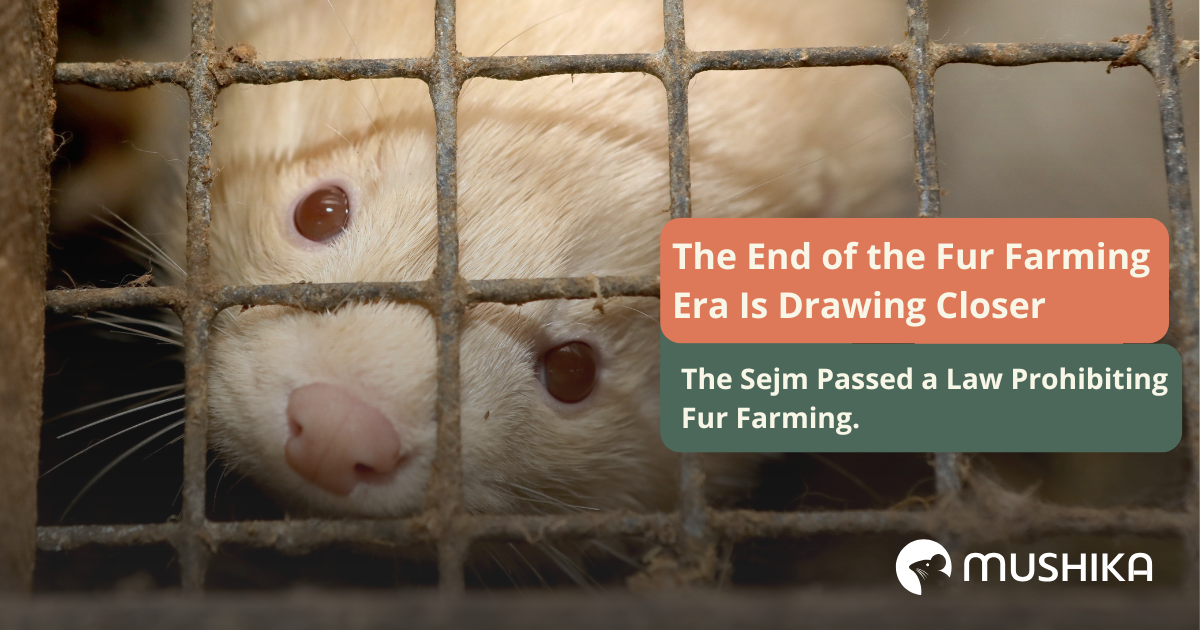
On 17 October 2025, the Sejm of the Republic of Poland passed a law introducing a nationwide ban on the commercial keeping and breeding of fur animals, with the exception of rabbits. This historic decision has the potential to finally end this long‑standing practice.
During the third reading of the bill, 436 MPs took part in the vote. 339 voted in favour, 78 against, and 19 abstained.
From Proposal to Adopted Law
The original draft of the bill assumed that fur farms would be closed by 2029. Following amendments submitted during the work of the Special Committee on Animal Protection, the deadline was extended to 31 December 2033, allowing entrepreneurs and farmers more time to wind down their operations and adapt to the changes.
The ban will cover both the operation of fur farms and any activity involving the keeping of animals for the purpose of obtaining their fur or other body parts. If the ban is violated, the court may impose a prohibition on owning any animals—or a specific category of animals—for a period of one to five years.
The Fur Industry in Poland
During parliamentary proceedings, the Ministry of Agriculture and Rural Development presented data showing that Poland currently has 281 fur farms, including 169 mink farms, 37 fox farms, 11 raccoon dog farms and 64 chinchilla farms. It is estimated that around 3.4 million animals were killed on these farms each year, and the value of fur and fur‑product exports reached €66 million annually.
Poland is one of the largest fur producers in the European Union. The Sejm’s decision aligns the country with the European trend — fur‑farming bans are already in place in 22 countries, including France, the Netherlands, Germany and Italy.
A Just Transition
The law provides a compensation mechanism for farmers and entrepreneurs who will incur losses due to the closure of their operations. Those planning to convert their farms into other agricultural or business activities will not need to reapply for an environmental decision if they previously held one. Fur‑farm workers will receive severance pay equal to 12 months’ salary, helping to mitigate the social impact of the industry’s phase‑out.
This framework lays the foundation for a just transition — combining animal protection with care for the people affected by the change.
As a foundation, we nevertheless hope that the phase‑out process will conclude earlier than 2033, supported by growing public awareness and the development of alternative economic activities.
The Voice of the Mushika Foundation
We support the solutions included in the law adopted by the Sejm. It is legislation that ends violence against animals while creating fair conditions for economic transition and protecting jobs.
This decision shows that it is possible to create laws that are wise, empathetic and just. Poland now has the opportunity to join the group of countries where legislation reflects society’s views on fur‑animal farming.
We submitted our opinion on the draft bills to the Special Committee on Animal Protection before the first reading, as described in our earlier article. Soon, we will present our position to the Senate of the Republic of Poland, expressing our support for the law and emphasising its importance for animal protection, the environment and the common good.
What’s Next? The Senate and the President
The law adopted by the Sejm will now be sent to the Senate, which has 30 days to adopt it without changes, introduce amendments or reject it entirely.
If the Senate does not adopt a resolution within 30 days, the law is considered passed in the version approved by the Sejm.
The law will then go to the President, who has 21 days to sign it and order its publication in the Journal of Laws. Before signing, the President may refer the law to the Constitutional Tribunal for review or — with a justified request — return it to the Sejm for reconsideration (a legislative veto).
A Step Toward a Better Future
The Sejm’s decision is a major step forward — but the journey is not over. We continue to follow the legislative process with hope, believing that Poland will soon become a country that permanently ends the farming of animals for fur.