Nutria in Poland: Between Law and Responsibility
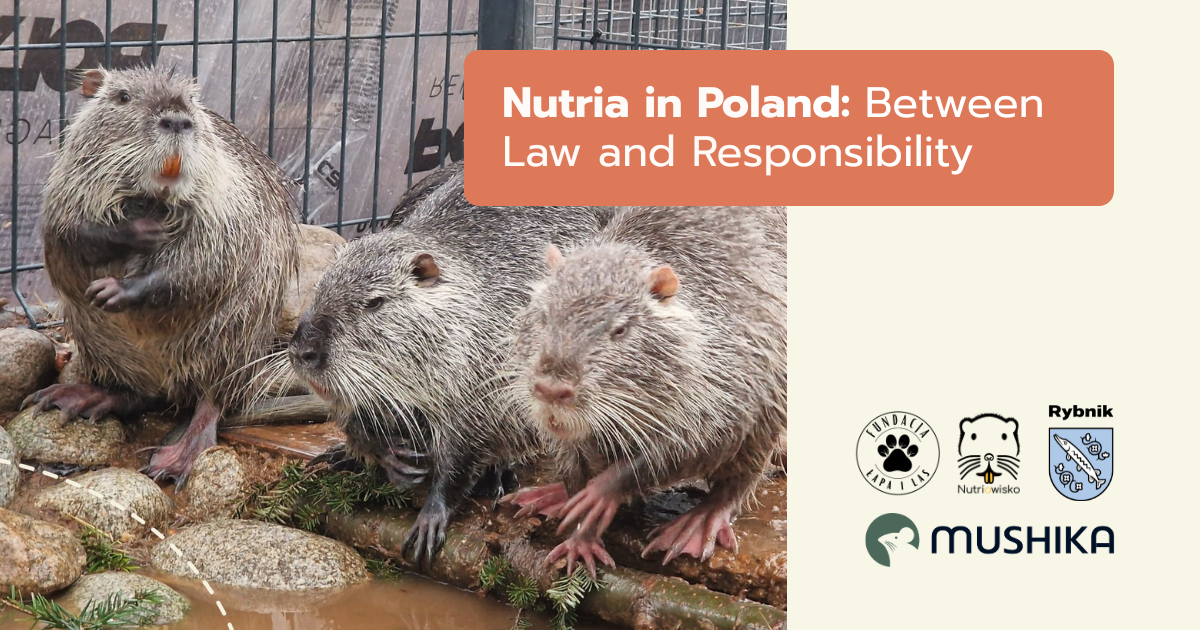
Just a few decades ago, the nutria was part of the fur industry. Today it has become an “environmental problem” that, under the law, should be eliminated. Nutria did not appear in Poland on their own – they were brought here by humans. And since humans changed the course of this story, it is also up to humans to decide how it ends: quickly and thoughtlessly, or responsibly and humanely.
Nutria in the light of the law
The nutria has been classified as an Invasive Alien Species (IAS) posing a threat to the European Union and, as such, requiring special control measures. In 2016, the European Commission placed the species on the EU list of invasive alien species of Union concern – a list that includes species subject to rapid eradication measures in order to prevent their further spread.
At the same time, nutria is also included on the national list of invasive alien species posing a threat to Poland, established by the Regulation of the Council of Ministers of 9 December 2022.
It is important to highlight, however, a significant difference between Poland and many Western European countries. In France, Italy, Spain, or the Netherlands, nutria populations are widespread and their complete removal from the environment is now practically impossible. In Poland, by contrast, the nutria population is relatively small and scattered. From the perspective of the national environmental administration, this creates a realistic possibility of completely eliminating the species from the wild. This circumstance – rather than the scale of actual damage – is the main reason for the urgency and strictness of measures taken against this species.
What does “rapid elimination” mean?
In legal language, “elimination” refers to removing a species from the natural environment. It is not synonymous with extermination, although the two are often confused in practice. Elimination can take different forms: from euthanizing animals to capturing them and permanently isolating them in conditions that prevent further reproduction.
The key objective is to stop reproduction as quickly as possible and prevent population growth. In the Polish context, time plays a decisive role: a few unnoticed individuals can multiply rapidly within a single breeding season, which may result in losing the opportunity to resolve the issue in a humane way.
Potential environmental impacts of nutria
According to analyses by the General Directorate for Environmental Protection (GDOŚ) – Poland’s central governmental body responsible for nature conservation – nutria may negatively affect ecosystems primarily through:
- destruction of aquatic and riverside vegetation,
- burrowing into riverbanks, canals, and reservoirs,
- weakening flood embankments and hydrotechnical infrastructure,
- competing with native species for food resources.
It should be noted, however, that the scale of these impacts in Poland is limited and cannot be compared with the situation in countries where nutria populations have been established for decades. In many regions of Poland, nutria presence has been local and so have the damages attributed to them.
Nutria in the ecosystem – a biological perspective
Every living organism that has survived the process of evolution fulfills a certain function in an ecosystem. The nutria – even though it lives in an environment that is not native to it – is not a biological “mistake”.
Its feeding activity may break up dense monocultures of vegetation, create passages in thick plant growth, and alter the structure of riverbanks.
In some cases, nutria may:
- contribute to reducing excessive floating vegetation (such as duckweed), which can improve light penetration and oxygen levels in the water,
- create burrows and small escarpments that may later be used by other animal species.
An example can be observed in the city of Rybnik in southern Poland, where kingfishers have been recorded nesting along the Ruda River. This bird species digs nesting burrows in steep sandy banks, which may sometimes form as a result of the activity of burrowing animals. Although it cannot be conclusively attributed to nutria, this example illustrates that the ecological effects of species interactions are rarely purely negative or purely positive.
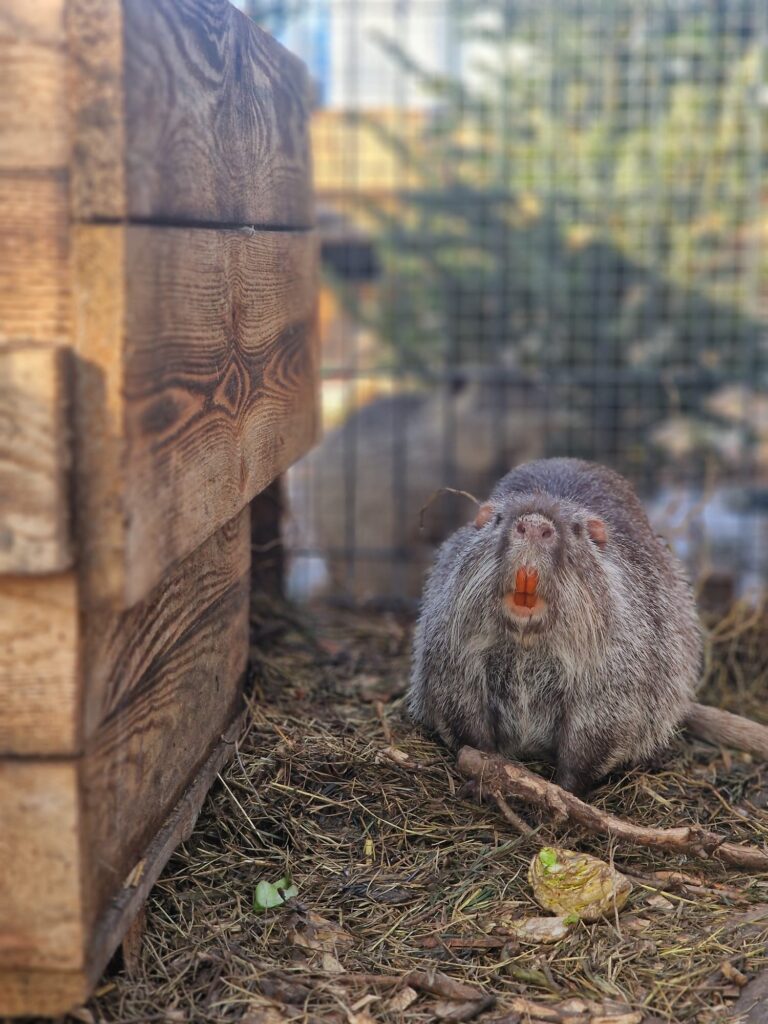
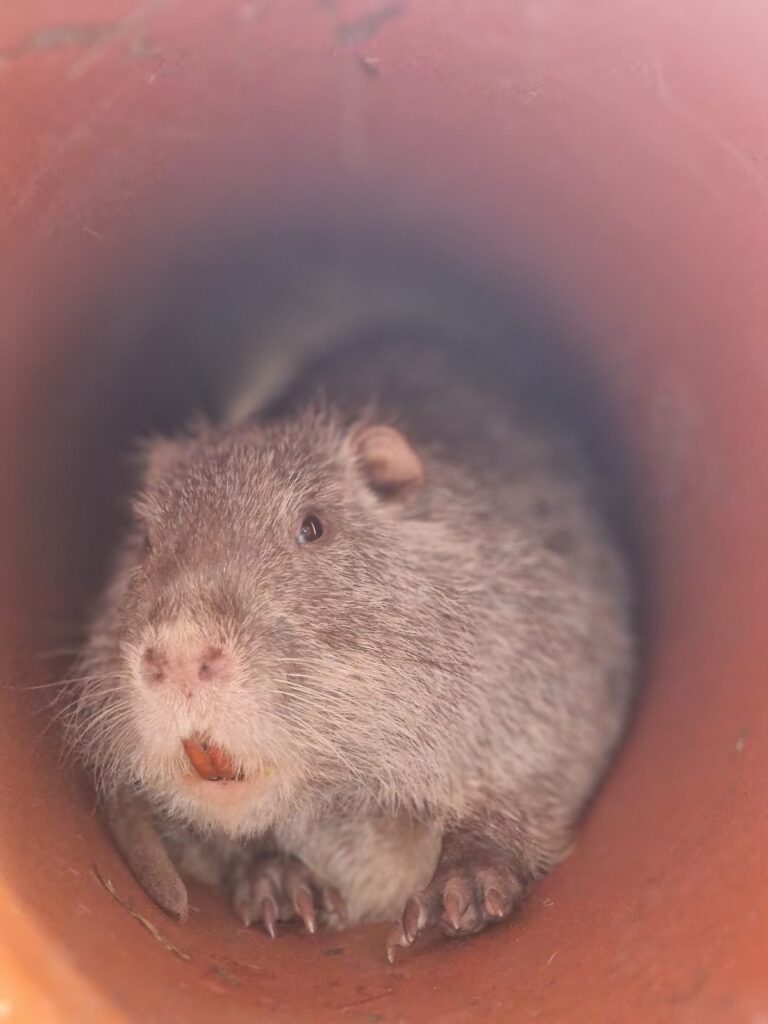
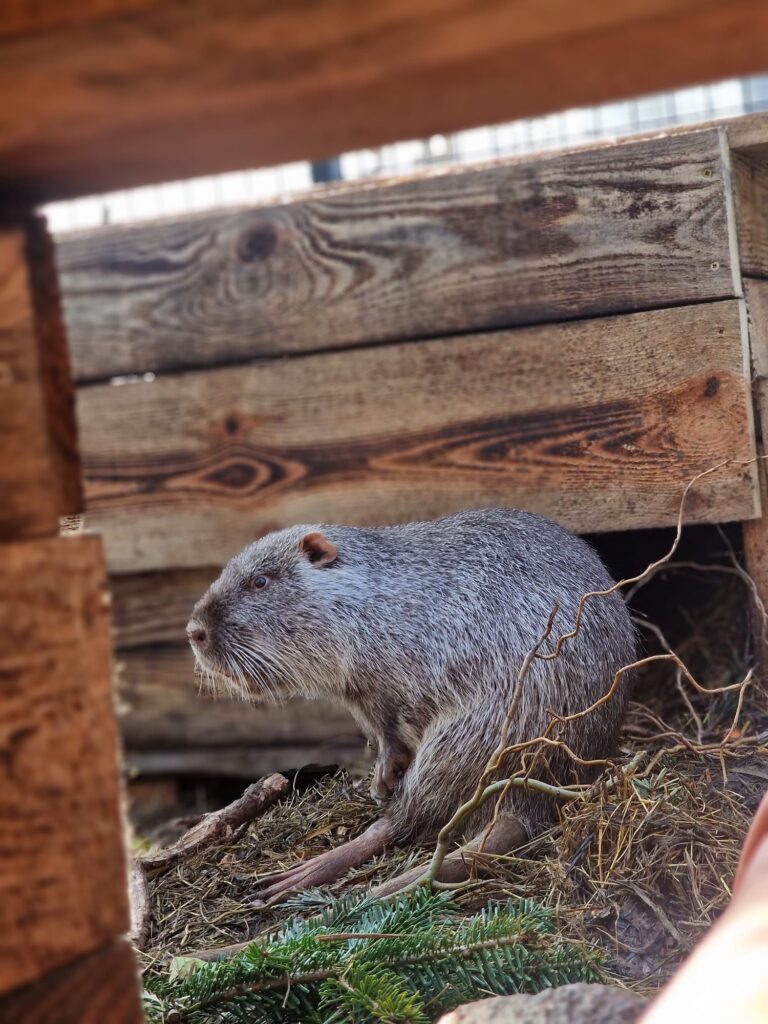
Nutria in the Nutriowisko sanctuary
Invasive does not mean “pest”
Describing nutria as an invasive alien species is sometimes mistakenly interpreted as labeling them a “pest”.
In reality, it is simply an administrative and legal classification describing a species’ relationship to a given ecosystem and the human responsibility associated with its presence.
Nutria did not “invade” Poland. They were brought here by humans and later abandoned in an environment that is not their natural home. Their reproduction and attempts to survive are completely natural behaviors. It is therefore humans who bear responsibility for resolving this situation in a way that is as humane and rational as possible.
Humane removal from the wild – the role of sanctuaries
One alternative to extermination is capturing the animals and placing them in specialized sanctuaries, where they are permanently isolated from the natural environment. In such facilities they cannot reproduce, but they can live out the rest of their lives in conditions that meet high animal welfare standards.
One such place is Nutriowisko, a sanctuary for nutria operated by the Łapa i Las Foundation in the city of Rybnik. The facility operates with official authorization from the General Director for Environmental Protection, the highest national authority responsible for nature conservation in Poland.
In 2025, thanks to a grant from the Mushika Foundation, awarded within a three-party agreement with the City of Rybnik, the Nutriowisko sanctuary significantly expanded its infrastructure, allowing it to support environmental protection efforts more effectively.
The Łapa i Las Foundation, in cooperation with the Mushika Foundation and the City of Rybnik, aims to develop a systemic and long-term solution to the nutria issue through sanctuary expansion, infrastructure development, and educational activities for the local community.
The goal is not only to protect animals but also to build awareness that nature conservation and humane treatment of animals are not mutually exclusive.
Nutria captured last year in the Silesian and Łódź regions of Poland were relocated to this sanctuary. The facility currently cares for more than eighty animals.
Responsibility instead of simplification
The story of nutria in Poland illustrates a complex conflict between law, biology, and ethics. Invasiveness is not the embodiment of “evil”, but rather a consequence of human decisions made decades ago. Today, our responsibility is to face the consequences of those decisions and choose solutions that minimize suffering while still protecting native ecosystems.
Humane removal of nutria from the Polish ecosystem to specialized sanctuaries will not solve every conservation challenge. However, it may become a model of responsible action – at least in situations where time, scale, and willingness to cooperate still make such solutions possible.