Why Should the Rodeo in Gliwice Not Take Place?
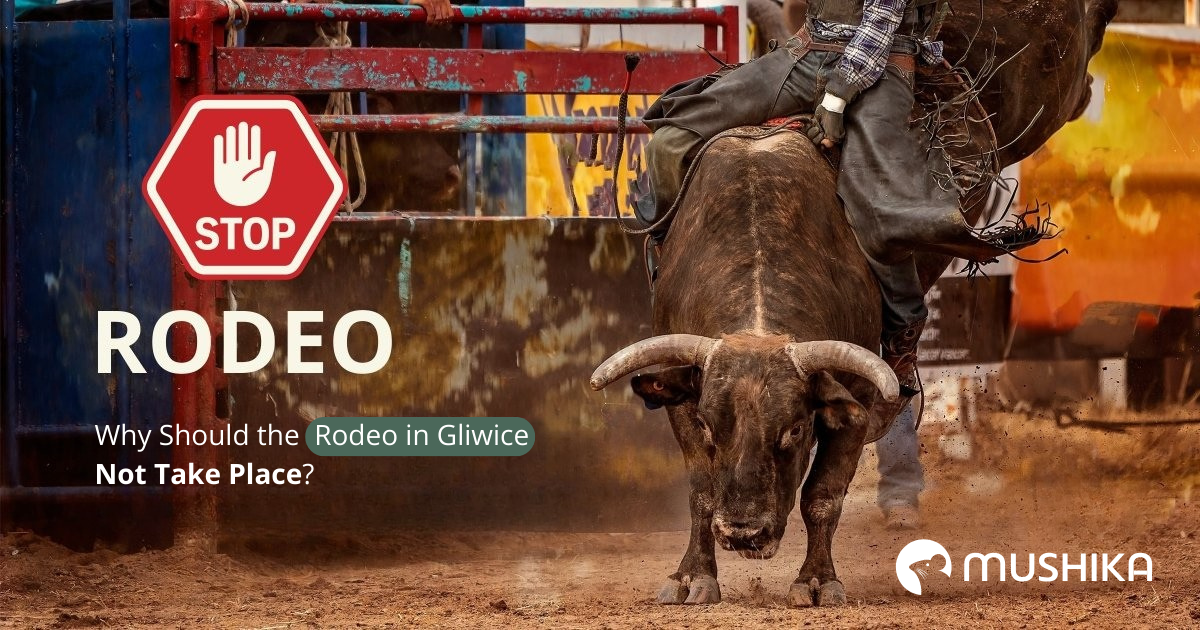
Can entertainment justify animal suffering? In the case of the planned rodeo in Gliwice, the answer seems clear. Concerns about the origin of the animals, the methods used on them, and the safety of participants—including children—raise serious ethical and legal questions. It is also troubling that the event is being held in a venue bearing the name of a company that publicly declares its commitment to environmental care—PreZero.
Mysterious Bulls – Where Do They Really Come From?
According to the event scenario, part of the show is to include “bull riding, a demonstration of riding specially prepared and trained bulls by experienced competitors who have repeatedly and actively competed across Europe.” The organizer claims that the bulls will come from Poland, from a herd registered under number 070540834‑001, due to the epizootic situation.
However, according to the register of the Agency for Restructuring and Modernisation of Agriculture as of 21 July 2025, no registered herd in Poland keeps a group of trained animals. This means the organizer’s declaration is not supported by available data.
Moreover, the event scenario provides no information about previous performances of these bulls in similar shows, nor about the individuals responsible for their training. It is unknown who trained them, what methods were used, or under what conditions the training took place. In the context of a bull‑riding show—which demands extreme physical and psychological reactions from animals—this lack of information is not only concerning; it may indicate a complete absence of professional preparation and disregard for animal welfare.
Suffering Built Into the Scenario
The event scenario includes the use of front and rear straps. Although such straps are normally used to stabilize a saddle, in this case they are to be independent of the saddle and serve as a means of stimulating the animals’ behavior. The flank strap compresses the sensitive area of the groin, triggering reactions similar to those of an animal defending itself from a predator—bucking, kicking, jumping.
This type of stimulation violates Article 17(4) of the Animal Protection Act, which prohibits forcing animals to perform actions that cause pain or are contrary to their nature.
Additionally, the organizer anticipates the presence of pharmacological agents for surgical interventions, euthanasia, and a company responsible for disposing of animal carcasses. This clearly indicates that the organizer acknowledges the possibility of serious injuries or even death of animals during the event. Such an approach contradicts Article 15(1) of the Animal Protection Act, which prohibits methods that cause suffering to animals used for entertainment.
Children in the Audience
The event website states that children under the age of 3 may enter for free. Moreover, no age restrictions have been introduced, meaning even the youngest children may attend a show that exposes them to scenes of violence against animals.
This decision raises serious ethical and educational concerns. Witnessing suffering, pain, panic, and aggression—both from animals and humans—can have a destructive impact on a child’s emotional development. Sensitivity, empathy, and the ability to feel compassion are shaped in the earliest years of life, and exposure to brutal scenes can disrupt this process.
Children do not have the cognitive or emotional tools to understand what is happening in the arena—they may instead internalize violence as something acceptable or even entertaining. The Ombudsperson for Children has issued a negative opinion on children’s participation in the event, urging the organizer to reconsider. Allowing children to attend such events not only violates principles of responsible upbringing but may also infringe upon their personal well‑being.
In the name of entertainment, children must not be exposed to suffering—neither of animals nor of people.
The City Has a Choice
The Act on the Safety of Mass Events obliges authorities to refuse permission if the organizer does not meet the requirements set out in the law—not only construction, sanitary, or fire safety regulations, but also those concerning animal protection (Article 29(4)(2) in connection with Article 6(1)(1) of the Act). This list of regulations is open, and failure to meet them should result in refusal.
The city has the tools to protect life and welfare—it simply needs to use them.
This is especially important because the event is being held in a venue branded by PreZero—a company that publicly declares its commitment to environmental care. Supporting an event in which animals suffer contradicts this image and may constitute an example of greenwashing—pretending to uphold ecological values while acting otherwise.
Declarations are not enough—actions matter. Supporting a rodeo by a company that claims to care for the planet not only undermines its credibility but may also violate applicable regulations. In this context, both the city and the event sponsor bear responsibility for the values they truly promote.