Towards a Future Without Cages. The Parliamentary Committee Begins Work on a Fur‑Farming Ban
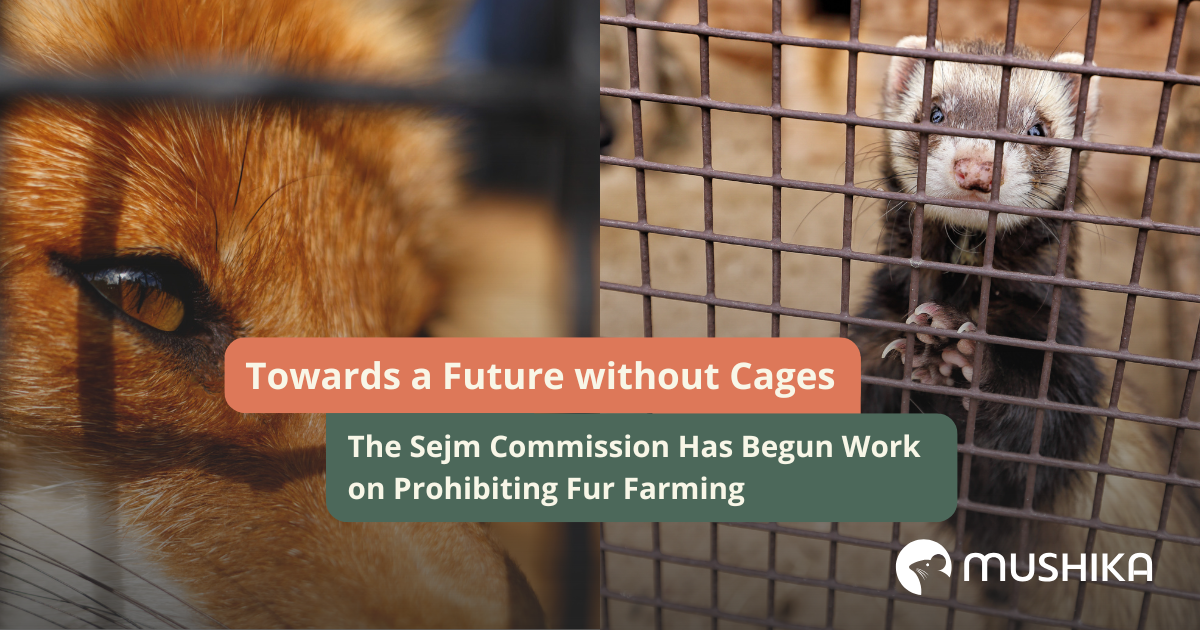
On 7 October 2025, a meeting of the Special Parliamentary Committee on Animal Protection was held, during which two draft bills introducing a ban on fur‑animal farming in Poland were read.
This marks the first step toward a change long awaited by both animal‑protection organisations and the majority of society: a decision to end the era of animals kept in cramped cages solely for profit.
Time for Real Change, Not Illusions
During the meeting, two draft bills were discussed. The parliamentary bill banning fur‑animal farming (Sejm print no. 703) provides for a four‑year transition period and a system of compensation for entrepreneurs and industry workers, allowing fur farms to be closed in a responsible and fair manner.
In contrast, the parliamentary bill amending the Animal Protection Act (Sejm print no. 835) proposes allowing fur farming to continue until 2039, which in practice would extend the current situation by another dozen or so years. In the view of the Mushika Foundation, such a long transition period undermines the very purpose of the ban—rather than protecting animals, it prolongs their suffering.
Mushika Foundation’s Position
The Mushika Foundation submitted its official position to the Committee prior to the meeting:
We believe that the solutions proposed in the bill with a four‑year transition period are balanced and responsible. They combine the need to protect animals with concern for the people who have operated in accordance with the law for many years.
“We express our full support for the core idea of both proposals—a ban on the commercial keeping and breeding of fur animals in Poland. This is a necessary step for our country to join the group of European states that have recognised that breeding animals solely for the purpose of obtaining fur is incompatible with modern ethical, scientific, and legal standards concerning animal welfare.” — wrote Katarzyna Wypychewicz, President of the Mushika Foundation, in a letter to the Committee.
By contrast, the proposal allowing fur farming to continue until 2039 is, in our view, merely superficial. We assess it negatively due to the lack of a real mechanism for phasing out the industry.
“A genuine legal change must produce real effects within a predictable timeframe. The proposal in Sejm print no. 835 does not guarantee such effects—on the contrary, it prolongs animal suffering and undermines public trust in state institutions.” — we stated in the Foundation’s opinion.
In line with its mission, the Mushika Foundation combines knowledge, empathy, and a systemic approach. Therefore, in the matter of banning fur‑animal farming, it calls for solutions that are wise, ethical, and effective.
What Happens Next?
Committee members may submit amendments to the draft bills until Friday, 10 October. The next meeting will take place the following week, when the Committee will discuss the amendments in detail—both those submitted by MPs and those proposed by social organisations and industry representatives.
The Mushika Foundation has already submitted its position and recommendations regarding the bill. At this stage, the decisions lie with the Committee and the parliamentarians, who will determine whether Poland truly chooses a future free from the suffering of fur animals.
We will continue to monitor the legislative process and—if the bill is passed by Parliament—we will present our position in the Senate as well. We hope that the final shape of the legislation will reflect the values of respect, empathy, and responsibility toward animals.
The Fur Industry in Poland
Poland’s fur industry is the largest in the European Union, comprising more than 250 farms where approximately 3.4 million animals—mainly minks and foxes—are killed each year. This type of farming is associated with severe animal suffering, as animals are confined in cramped cages and deprived of the ability to perform natural behaviours. It also generates significant environmental damage, including water and soil pollution and the emission of toxic chemicals during skin processing.
Despite bans in 22 EU countries, Poland still allows fur production, raising ethical, ecological, and public‑health concerns.